

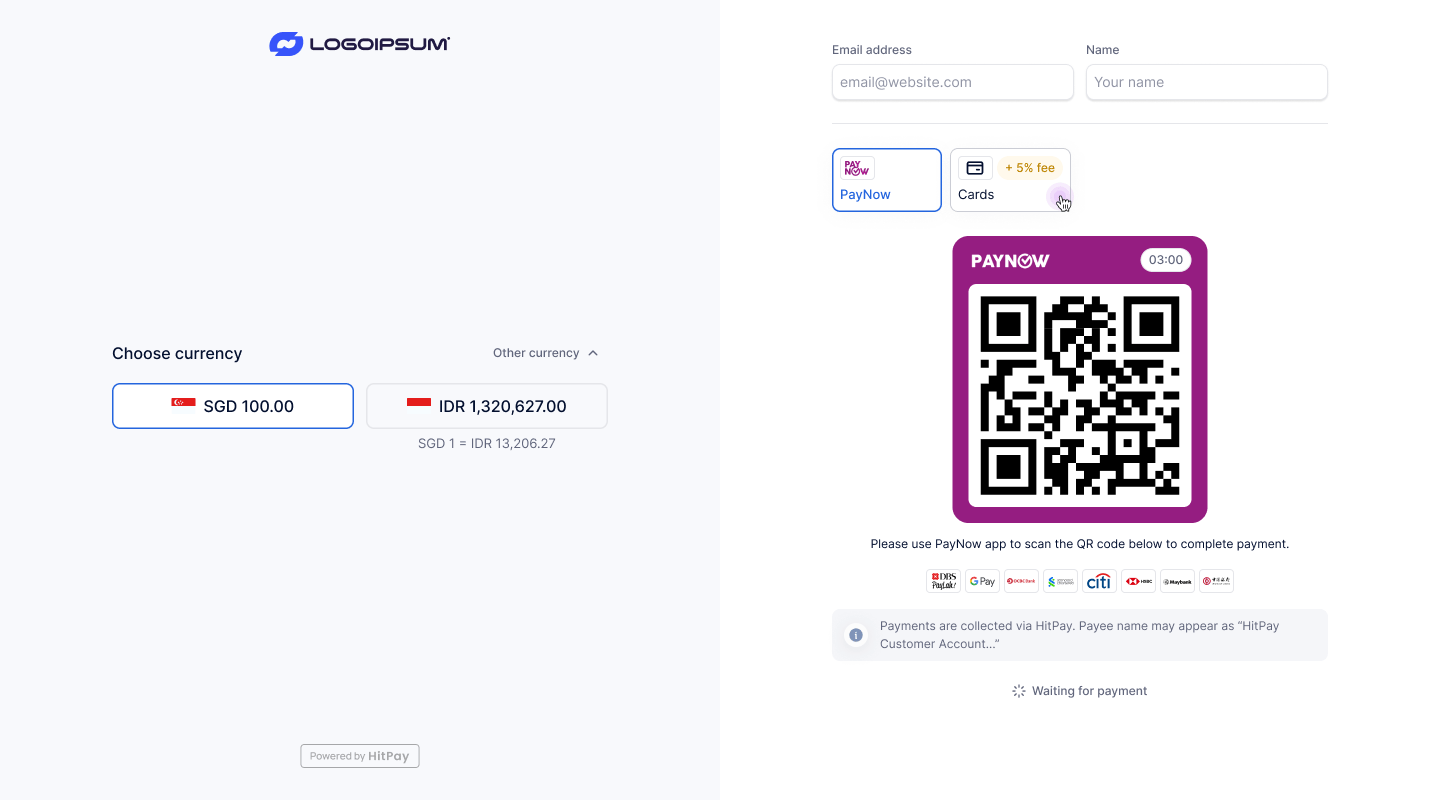
Charge in your home currency. Let customers pay in theirs.
HitPay Adaptive Pricing lets online merchants serve international customers without creating separate payment links per currency. When a customer from overseas lands on your hosted checkout, HitPay detects their location and automatically shows the amount in their local currency with local payment methods — while you still receive your home currency payout.Get HitPay Adaptive Pricing
Start accepting cross-border payments online
See how it works
Learn the simple checkout flow
How It Works
1
Merchant creates a payment request in their home currency
You create a payment link or hosted checkout as normal, priced in your home currency (e.g. SGD 120).
2
Customer opens the checkout
HitPay detects the customer’s location via IP address and determines their likely local currency (e.g. IDR, MYR, THB, PHP).
3
Customer sees and selects their local currency
If the detected currency differs from the merchant’s default currency, the checkout displays a currency selector. The customer sees the converted amount in their local currency alongside relevant local payment methods. The FX rate is locked at page load and refreshes on reload.
4
Customer pays, merchant receives home currency
The customer pays in their local currency using their preferred local payment method. HitPay handles the FX conversion automatically and credits the merchant’s payout in their home currency.
Supported Payment Methods
Without Adaptive Pricing, overseas customers can only pay by card in a foreign currency. Adaptive Pricing unlocks local payment methods — such as QRIS, DuitNow, PromptPay, QR Ph, and VietQR — so customers pay in their own currency using methods they already trust. See the full list on the Cross-Border Payments page.How to Set Up
1
Create a HitPay account
Sign up for HitPay if you haven’t already, and complete account verification.
2
Enable cross-border payment methods
Navigate to Settings > Payment Methods and connect the cross-border payment methods you want to support (e.g. QRIS, DuitNow, PromptPay, QR Ph, VietQR).
Partner providers review new requests within 3–5 business days.
3
Enable Adaptive Pricing in Checkout Customisation
Go to Settings > Checkout Customisation > Adaptive Pricing and turn on the Enable Adaptive Pricing toggle. Save your settings.Once enabled, all hosted checkout sessions for your account will automatically activate adaptive pricing for international customers.
How Fees Work
Example scenario: A Singapore merchant charges SGD 100 to a customer in Indonesia.
- Merchant creates a payment request for SGD 100
- Indonesian customer opens the checkout link
- HitPay detects an Indonesian IP and displays the equivalent in IDR with QRIS as a payment option
- Customer selects IDR, sees the converted amount, and pays via QRIS
- Merchant receives payout in SGD
Fees borne by Merchant
The FX conversion fee is an additional 2% charged on card transactions where the card’s billing currency differs from the charge currency. Local payment methods processed via Adaptive Pricing are not subject to this fee, which is why it disappears in the With Adaptive Pricing column.
Your settlement amount is the customer’s IDR payment converted back to SGD at the time of settlement. Because the IDR→SGD rate may differ slightly from the SGD→IDR rate shown at checkout, the amount settled may be marginally less than the original SGD 100 requested — before fees are deducted. Your HitPay dashboard shows the exact settlement and net amounts for each transaction.
Adaptive Pricing also works with cards — and still improves conversion. When customers see the price in their local currency, they are more likely to complete the purchase even if they choose to pay by card. Fee breakdown for card payments with Adaptive Pricing:
Fees borne by Customer
Without Adaptive Pricing, the Indonesian customer’s bank performs the SGD→IDR conversion and typically charges a 4–5% FX surcharge on top of an unfavourable rate — a hidden cost the customer only sees on their bank statement. With Adaptive Pricing, the customer pays in IDR at the mid-market rate with no bank FX fee, and the merchant’s payout in SGD is unaffected.
Restrictions
Adaptive Pricing is not available for the following:- Default payment link — The default payment link on your account does not support Adaptive Pricing.
- Open amount payment links — Payment links without a fixed amount set are not eligible for currency conversion.
Frequently Asked Questions
Which customers see the currency selector?
Which customers see the currency selector?
Only customers whose detected country maps to a currency that differs from the merchant’s default currency. Domestic customers (same currency as the merchant) see the standard checkout with no currency selector.
How is the exchange rate determined?
How is the exchange rate determined?
The rate is based on the mid-market exchange rate at the time the checkout page loads. The FX rate and associated FX cost are borne by the customer — the merchant always receives their payout in their home currency. The rate is locked for the duration of that checkout session and refreshes when the customer reloads the page.
What if a customer's currency is not supported?
What if a customer's currency is not supported?
If the detected currency is not supported or matches the merchant’s default currency, the checkout falls back to showing only the merchant’s default currency and payment methods — no currency selector is shown.
Does Adaptive Pricing work with API-created payment requests?
Does Adaptive Pricing work with API-created payment requests?
Yes. Payment requests created via the API also support adaptive pricing on the hosted checkout, as long as Adaptive Pricing is enabled in your Checkout Customisation settings.
Does Adaptive Pricing work with recurring billing or subscriptions?
Does Adaptive Pricing work with recurring billing or subscriptions?
No. Adaptive Pricing is currently available for one-time hosted checkout payments only. Recurring billing and subscription charges are out of scope for this feature.
Will my customer be charged exactly the amount shown at checkout?
Will my customer be charged exactly the amount shown at checkout?
It depends on how they pay.Local payment method (e.g. QRIS, DuitNow, PromptPay): Yes — the customer pays exactly the local currency amount displayed at checkout. HitPay does not add any charges on top of what is shown. Your customers can confidently share this with their own customers.Card: The customer is charged the displayed local currency amount by HitPay. However, if their card issuer applies a foreign transaction fee or uses their own exchange rate, an additional charge may appear on the customer’s bank statement. This is outside HitPay’s control and varies by the customer’s bank and card type.
What card fees apply with Adaptive Pricing?
What card fees apply with Adaptive Pricing?
Card fees are borne by the merchant, not the customer. When a customer pays by card with Adaptive Pricing enabled, the merchant is charged:
The FX conversion fee applies because the card’s billing currency differs from the charge currency. This is the same rate as without Adaptive Pricing — the benefit for cards is improved conversion, since customers are more likely to complete a purchase when they see the price in their local currency.
What is the payout period?
What is the payout period?
Cross-border payments processed via Adaptive Pricing are credited to your HitPay Balance on a T+1 calendar day basis.
Testing
To test local currency presentment, pass a location-formatted email address that includes a+location_XX suffix — where XX is a valid two-letter ISO country code — as the customer email when creating a payment request.
For example, to simulate a customer in France, use an email like [email protected]. When the checkout is opened, HitPay will present the currency as a customer in that country would see it.
You can do this in two ways:
- API — Set the
emailfield to a location-formatted address when creating a payment request via the Payment Request API. - Dashboard — When sending a payment link by email, enter a location-formatted address (e.g.
[email protected]) in the email field.
For Developers
Payment Request API
Integrate adaptive pricing into your custom checkout via the Payment Request API. The
localised_pricing parameter enables currency selection on the hosted checkout page.